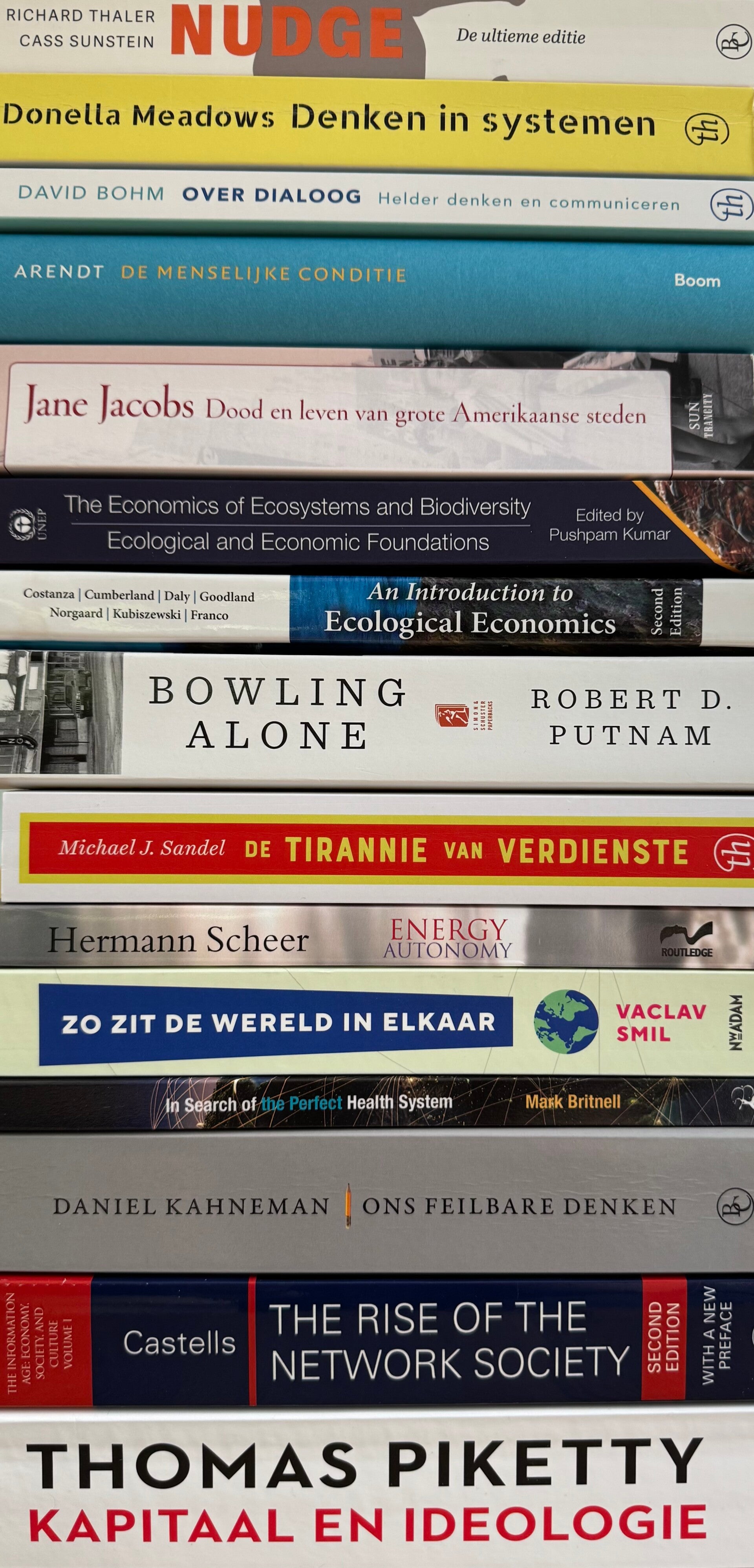
Transdisciplinary Dialogue Framework
References & Transdisciplinary Framework
My transdisciplinary framework is structured around seven underlying dimensionsthat together shape how value emerges, is sustained, or comes under pressure.
1. Ecological Foundations
Within what planetary and ecological boundaries do we live and produce?
Every society and economy is embedded in physical and ecological systems. Water, energy, biodiversity, natural resources and ecosystems are not external factors, but the conditions that make human systems possible in the first place.
Foundational Thinkers
Paul A. Samuelson: represents the modern neoclassical economic tradition, in which economic choice, allocation and efficiency are central. His work provides an important reference point for the economic paradigm within which later ecological critiques developed.
Nicolas Georgescu-Roegen: economics as a physical process, with particular attention to energy, entropy and the fundamental limits to economic growth.
Herman Daly: ecological economics, steady-state economics, and the relationship between economy, society and ecological boundaries.
Contributing Thinkers
Robert Costanza · Peter Victor · Pushpam Kumar · Johan Rockström · Saleh El Serafy · Gretchen Daily · Clive Hamilton · Mark Diesendorf · Hermann Scheer · Jules Pretty · Giulio Boccaletti · Julia Martin-Ortega · Janine Benyus · Stephen Gliessman · Pablo Tittonell · Daniel Wahl · Thomas Lagoarde-Segot · Clive Spash · Tim Lenton · Murray Bookchin · Vaclav Smil
Key Insight
Economic value cannot be separated from the physical and ecological conditions within which it emerges.
2. Complexity & Systems Dynamics
How do natural, social and economic systems interact?
Complex systems do not consist of isolated parts. Patterns emerge through relationships, feedback, communication, dependencies and interactions across different levels.
Foundational Thinkers
Gregory Bateson: thinking in terms of patterns and relationships; connecting ecology, communication, learning and systems dynamics. His work demonstrates that meaning and behaviour cannot be separated from the relational context in which they emerge.
Donella Meadows: system structures, feedback and leverage points for change.
Niklas Luhmann: society as a system of communication and the ongoing reproduction of social meaning.
Fritjof Capra: systems thinking and the interconnectedness of living, social and ecological systems.
David Bohm: thought as a system and dialogue as a means of making underlying patterns and assumptions visible.
Contributing Thinkers
Peter Senge · Nora Bateson · Brian Walker · Otto Scharmer
Key Insight
The properties of a system emerge partly from the relationships between its elements; meaningful change therefore requires an understanding of patterns and feedback, not merely of individual components.
3. Institutions, Power & Public Value
How do we organise collective value, and who determines the rules?
Markets, governments, organisations and institutions determine how resources, power, opportunities and responsibilities are distributed. They therefore influence not only the distribution of value, but also the conditions under which value can emerge.
Foundational Thinkers
Karl Polanyi: the economy is embedded in social, political and institutional relationships. Market mechanisms therefore cannot be separated from the society in which they operate.
Elinor Ostrom: communities can, under certain conditions, develop durable institutions for managing shared resources and organising collective action.
Mariana Mazzucato: value creation is not exclusively the result of private market activity. The public sector can actively create value, shape markets and provide direction for societal transitions.
Barry Bozeman: public value and public interest as foundations for asking which values the public sphere should protect and how public value can be assessed.
Contributing Thinkers
Mark Moore · Katharina Pistor · Thomas Piketty · Dani Rodrik · Daron Acemoglu · Mark Granovetter · Karl Popper
Key Insight
Value does not emerge from transactions alone. Institutional structures help determine which values are encouraged, distributed, protected or eroded.
4. Meaning, Dialogue & Encounter
How do understanding, meaning and shared judgement emerge?
Social action begins with observing, interpreting and understanding. Meaning does not arise solely at the individual level, but also through encounter, language, dialogue and the confrontation of different perspectives.
Foundational Thinkers
Hans-Georg Gadamer: understanding as a hermeneutic process. Genuine understanding emerges through encountering another perspective and requires openness to what becomes possible in dialogue.
Hannah Arendt: plurality, thinking, judgement and action in the public realm. We share a world precisely because we can see and discuss it from different perspectives.
Karl Popper: openness, critical rationality and the continual possibility of correcting knowledge and beliefs. No perspective is final; collective thinking requires room for criticism.
Contributing Thinkers
David Bohm · Martin Buber · Emmanuel Levinas · Jürgen Habermas · Martin Heidegger · Bruno Latour · D.G. Merzel
Key Insight
Sound judgement does not arise from optimising a single perspective, but from bringing different perspectives into.
5. Social Change, Networks & Acceleration
How do people, relationships and institutions change over time?
Societies are constantly changing. This change is shaped by power relations, interdependence, technology, networks, human cognition and the increasing speed of social processes.
Foundational Thinkers
Norbert Elias: social development as a long-term process of changing interdependencies and social figurations.
Hartmut Rosa: modernisation as a process of social acceleration and a changing relationship between people and the world.
Daniel Kahneman: human perception, judgement and decision-making under conditions of limited attention, time and information. His distinction between fast and more reflective modes of thinking highlights how people form judgements within complex and rapidly changing environments.
Contributing Thinkers
Manuel Castells · Zygmunt Bauman · Sherry Turkle · Jean Twenge · Jonathan Haidt · Herbert Simon · Richard Thaler · Michael Sandel · Deborah Chambers
Key Insight
Social change is not a linear process. It emerges from changing relationships, dependencies, institutions, human perceptions and temporal dynamics.
6. Living Environment & Social Cohesion
Where does social value become tangible in everyday life?
Value is ultimately experienced in concrete places, communities and relationships. The design of the living environment influences the possibilities for encounter, trust, belonging and participation.
Foundational Thinkers
Jane Jacobs: urban diversity, human scale and the social dynamics of cities. A vital city emerges through the continuous interaction of people, functions and places.
Jan Gehl: human scale and the physical conditions that enable encounter. The quality of public space directly influences how people move through, inhabit and interact within a city.
Robert Putnam: social capital, trust and the quality of social connections. Social networks and reciprocity are important conditions for a vital society.
Contributing Thinkers
Ray Oldenburg · Carlos Moreno · Richard Florida · Charles Landry · Pierre Bourdieu · Ivan Illich · Mark Britnell
Key Insight
The quality of the living environment influences the possibilities for encounter, connection and the development of social capital.
7. Strategy, Value Creation & Reflective Practice
How do we translate insight into action under uncertainty?
Insight only becomes meaningful when it informs action. Strategy is therefore not solely about efficiency or competition, but about making directional choices, learning and developing the capacity to act within complex and changing environments.
Foundational Thinkers
Michael Porter: strategy as making choices, creating distinctive positioning and consciously determining where and how value is created.
Henry Mintzberg: strategy as a combination of deliberate and emergent strategy. Strategy does not only precede action; it also develops through learning, experience and interaction with the environment.
Donald Schön: the professional as a reflective practitioner. Effective action emerges through continuous reflection in and on practice, particularly when established rules and models prove insufficient.
Nassim Nicholas Taleb: dealing with uncertainty, vulnerability, robustness and antifragility. Rather than attempting to predict the future completely, the focus is on developing systems capable of absorbing and responding to uncertainty.
Contributing Thinkers
James Brian Quinn · Philip Kotler · Kevin Lane Keller · Tim Koller · Noriaki Kano · C.M. Storm · Frederick Herzberg · Clayton Christensen · Michael Polanyi · Peter Attia
Key Insight
Strategy is not about predicting the future, but about developing the capacity to act under uncertainty.
Conclusion
These references are not an endpoint, but part of an ongoing intellectual journey.
The different thinkers do not necessarily offer a single unified theory. Rather, they provide different perspectives through which complex social, economic and ecological realities can be explored and brought into dialogue.
The underlying question remains:
How do we organise systems that are not only efficient, but also sustainable, just and meaningful?
Adres
Houtlaan 201
9403 EZ Assen
Netherlands