
Transdisciplinairy Dialogue Framework
The quality of systems is determined by the quality of the relationships that sustain them.
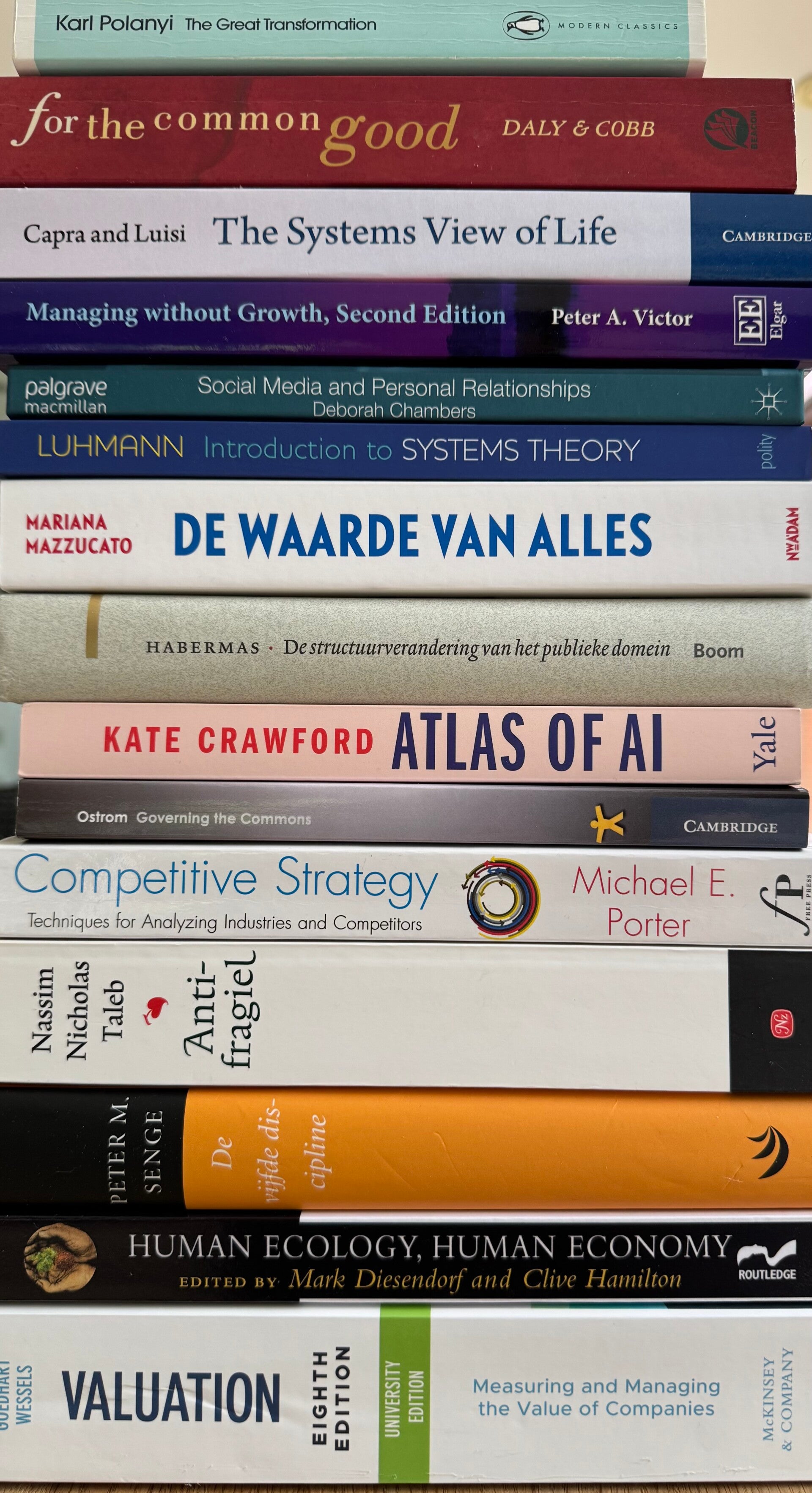
Transdisciplinary Dialogue Framework
For Governance, Strategy & Judgement Under Uncertainty
The quality of a society is shaped in part by the quality of the relationships through which people encounter one another, create meaning and act.
Value does not arise in isolation. It emerges through the interaction between human needs and goals on the one hand, and the physical, ecological and social realities on the other. It manifests itself in relationships, networks, institutions and in the ways people relate to one another and to their environment.
Most approaches to governance and strategy focus on systems: structures, models, processes and incentives.
When decision-making fails, this is rarely due to the model alone. More often, it is related to the quality of judgement within the system.
This framework starts from a different premise:
Systems do not create value independently. They help determine the conditions under which value can emerge, be distributed and be appropriated.
Economic and social systems do not exist separately from their ecological reality. They depend on matter, energy, natural systems and human relationships, while simultaneously influencing them.
This framework connects practical experience with insights from economics, ecology, systems thinking, philosophy and sociology, through a relational perspective on value, judgement and societal development.
Two Operational Dimensions
In practice, this framework operates along two interconnected dimensions:
A. Context
The ecological, social and institutional conditions within which people and organisations act.
This includes not only formal structures and rules, but also dependencies, power relations, available resources, shared meanings, and the physical and ecological reality within which systems function.
B. Capacity for Judgement
How individuals and groups perceive, make meaning, deal with uncertainty and act.
The capacity for judgement is never solely an individual attribute. It emerges and develops within relationships, institutions and social contexts.
Why This Matters
In an environment of increasing complexity:
– models become more sophisticated
– data becomes more abundant
– strategies become more advanced
And yet the quality of decision-making does not automatically improve.
One variable often remains out of sight:
the quality of the interaction through which perception, meaning-making and judgement emerge.
There is a second question:
What conception of value actually underlies the decisions we make?
What we define as value determines what we measure, reward, protect and develop.
Social Soil
Every system rests on a relational foundation.
I call this social soil: the quality of trust, dialogue, reciprocity and shared meaning within which people and organisations can perceive, learn and act.
This social soil is shaped in part by institutions, economic relationships, dependencies and the history of a society.
Where this soil is weak:
– governance becomes procedural
– strategy becomes performative
– risk management becomes reactive
– the capacity to genuinely learn becomes diminished
Where it is strong:
– judgement improves
– complexity becomes more manageable
– space emerges for learning and adaptation
– value can be developed over the longer term
Social soil is therefore not a soft condition alongside the hard reality of systems. It is part of the infrastructure within which systems function.
Value & Systems
Economic activity is often assessed in terms of production, growth and financial returns.
Yet production can create value while simultaneously causing harm. And the subsequent restoration of that harm can itself appear as economic activity.
This raises a fundamental question:
What do we actually mean by value, and which activities contribute to it?
An economy is not a closed system. It uses matter and energy, depends on ecological processes and is embedded in social relationships.
The question of value is therefore always also a question of:
– what is produced
– what is consumed
– what is preserved
– what is degraded
– who creates value
– who benefits from it
– and who bears the costs
This perspective makes it possible to look beyond purely financial or economic indicators towards the broader conditions under which societal value emerges.
What This Framework Does
This is not a model to be applied, but a framework to work with.
It helps to:
– diagnose where systems and judgement become disconnected
– make visible what is not seen or said
– uncover underlying assumptions about value
– examine relationships, dependencies and system conditions
– strengthen the conditions for better judgement and better decision-making
Not by reducing complexity, but by increasing clarity within it.
Sources of Insight
This framework draws on a range of intellectual traditions, including:
– philosophy of encounter and dialogue
– sociology of modernity, interdependence and systems
– behavioural and cognitive approaches
– governance, strategy and theories of value
– urban and social theory concerning public space
– ecological economics and systems thinking
– theories of economic value, public value and value creation
These traditions are not merged into a single, closed theory. Rather, they are placed in relation to one another.
Insight emerges between perspectives, not from any single perspective alone.
The integration of economics and ecology is not treated as a separate domain, but as an underlying condition.
Economic systems exist within physical reality. They depend on ecological boundaries, matter and energy, as well as on the social relationships and institutions that help shape that reality.
Application
Oversight & Governance
Beyond compliance and control:
Do we understand the conditions under which sound judgement emerges?
And do we examine the conception of value underlying policy and decision-making?
Strategy & Organisations
Beyond optimisation:
Are we working with the relational, social and ecological conditions that determine long-term value?
Transformation & Risk
Beyond models:
Are we capable of seeing what is actually happening, making sense of uncertainty and acting accordingly?
Public Value
Beyond economic output:
What value is being created, for whom, under what conditions — and which costs or forms of harm are shifted onto others or into the future?
About
With more than 30 years of experience as an international entrepreneur, supervisory board member and advisor to executive boards and CEOs, I work at the intersection of governance, strategy and value creation in complex transnational environments.
My work connects system dynamics, ecological boundaries and relational quality with questions of decision-making, transformation and long-term value.
My exploration of where real value emerges began around 1990: intuitive, interdisciplinary and relational in nature, long before I had the language to articulate it.
Over time, it became clear that questions of economics, ecology, organisation and society cannot be understood separately.
Not because everything constitutes a single system, but because these different realities continuously influence one another.
Closing
As systems become more complex and structures more diffuse, the central question shifts:
not only how we organise,
but how we perceive, judge and relate to one another and to our environment.
The quality of our society is ultimately shaped by the quality of the space between us.
Let’s talk…
Egbert Hengelmolen
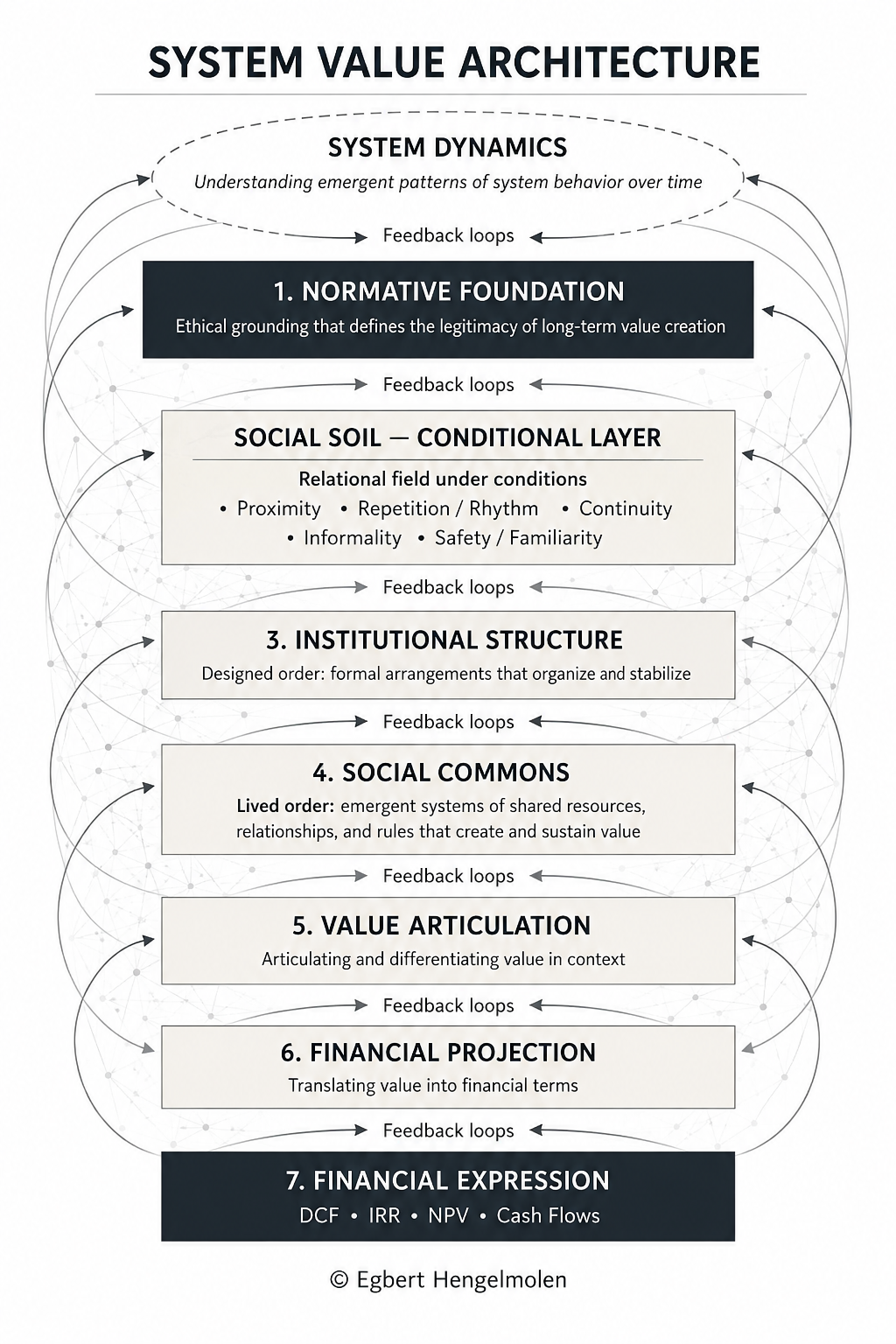
What is often overlooked
How value actually emerges in organizations
Value does not emerge from strategy alone.
Nor from structure or financial models.
It emerges in the interaction between normative choices, system dynamics, and the quality of relationships.
This model makes visible what is often overlooked:
that value depends on conditions — proximity, rhythm, continuity, safety —
and that financial outcomes are an expression, not a starting point.
It is not a model to apply, but a way of seeing.
Adres
Houtlaan 201
9403 EZ Assen
Netherlands